Is M-Pesa API Free? Daraja API Cost Breakdown 2026
The Short Answer: Free to Access, Not Free to Implement
Yes — Safaricom's M-Pesa API is free to access. But free API access and free implementation are two completely different things, and confusing them is one of the most expensive mistakes Kenyan businesses make when planning a payment integration.
This guide breaks down exactly what costs nothing, what costs money, and what the realistic budget looks like for a proper M-Pesa integration in 2026.
Quick Takeaway
Daraja API registration and sandbox testing are free. The development, server setup, SSL certificate, and ongoing maintenance are not. Total implementation cost ranges from KSh 30,000 for a basic STK Push to KSh 150,000+ for a full integration with B2C and reconciliation. Your time has a cost too — DIY takes 40–80 hours minimum.
What "Free API" Actually Means
When Safaricom says the Daraja API is free, they mean:
No monthly subscription or license fee to access the API
No charge to create a developer account on the Daraja portal
No cost to use the sandbox testing environment
No per-request fee charged by Safaricom for API calls
What you're getting for free is access to the technical interface — the documentation, the credentials, the test environment. You're not getting a working payment system.
Think of it like this:
The road to your business is free to use, but building the road itself is not.
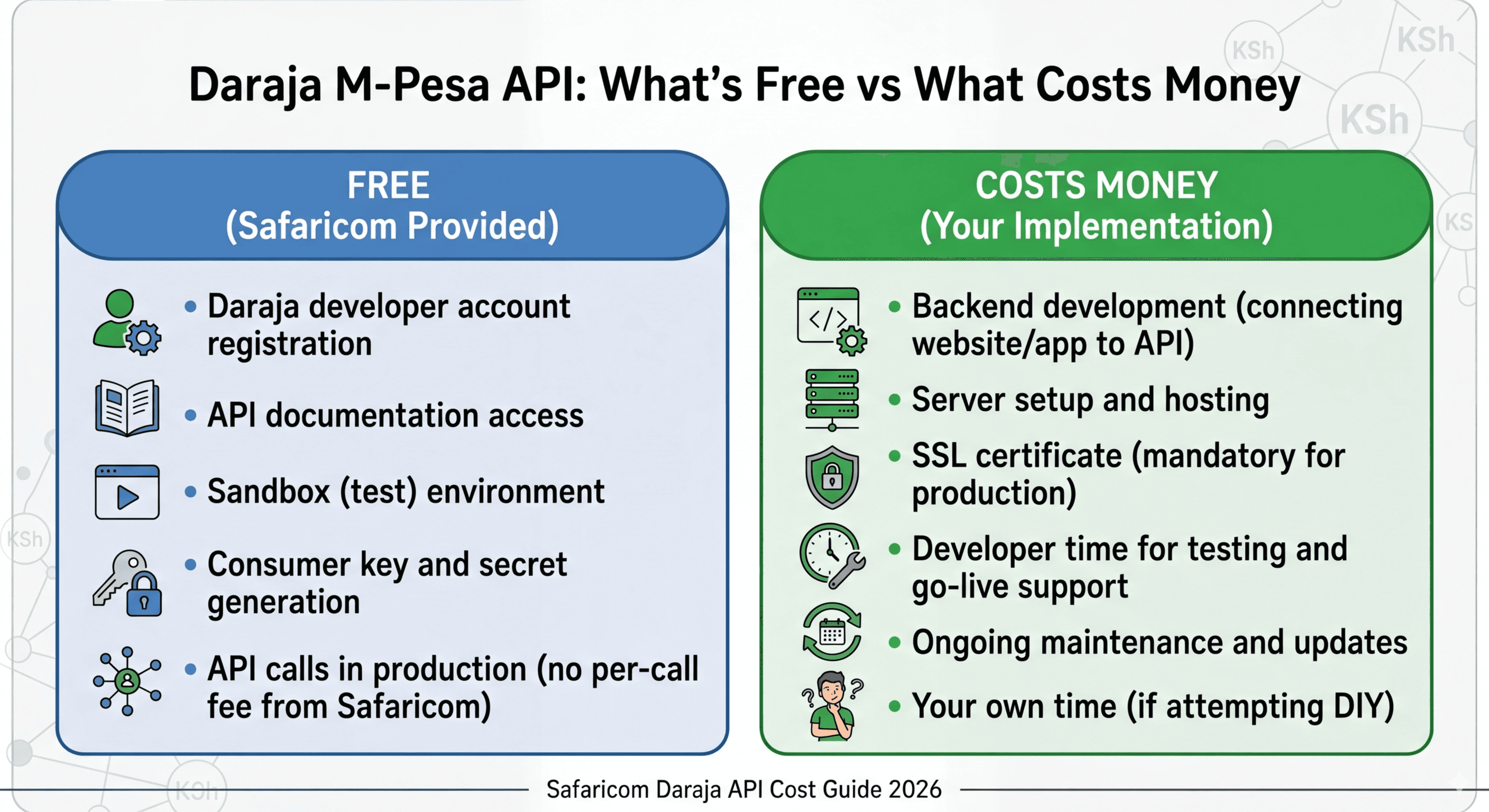
What's Free vs What Costs Money
Free:
Daraja developer account registration
API documentation access
Sandbox (test) environment
Consumer key and secret generation
API calls in production (no per-call fee from Safaricom)
Costs money:
Backend development to connect your website to the API
Server setup and hosting
SSL certificate (mandatory for production)
Developer time for testing and go-live support
Ongoing maintenance and updates
Your own time if you attempt DIY
The Real Implementation Costs in 2026
Here's what a proper M-Pesa integration actually costs for a Kenyan business:
Basic STK Push integration (C2B payments only)
Developer cost: KSh 30,000 – 60,000
SSL certificate: KSh 5,000 – 15,000/year
Server/hosting: KSh 3,000 – 8,000/month depending on provider
Timeline: 2–3 weeks with an experienced developer
Full integration (STK Push + B2C payouts + reconciliation)
Developer cost: KSh 80,000 – 150,000
SSL certificate: KSh 5,000 – 20,000/year
Server/hosting: KSh 5,000 – 12,000/month
Timeline: 4–6 weeks
Ongoing maintenance
Monthly retainer: KSh 5,000 – 15,000
This covers Safaricom API updates, token refresh logic, monitoring, and bug fixes.
Skipping maintenance is how integrations that worked at launch start failing six months later.
M-Pesa Transaction Fees — Separate From Integration Costs
This is a separate cost that applies regardless of whether you use direct Daraja integration or a gateway like Paystack.
When a customer pays via M-Pesa, Safaricom's standard transaction fees apply on the customer's side. On the business side, Paybill and Till number fee structures differ slightly.
Your Safaricom business relationship manager can give you the current schedule based on your expected volumes.
These fees exist with or without API integration. The API itself doesn't add to them.
Can You Really Do It Yourself for Free?
Technically yes. Practically, it depends on your skill level and what your time is worth.
DIY M-Pesa integration requires solid backend development knowledge — PHP, Node.js, Python or similar.
You need to understand OAuth token lifecycles, callback handling, server configuration, and SSL setup. The Daraja documentation has improved but still has gaps that require community knowledge to fill.
Realistic time investment for a first-time implementation: 40–80 hours. For an experienced developer who has done it before: 15–25 hours.
If you're a business owner, not a developer, those 40–80 hours have a real opportunity cost.
If you're a developer learning the integration for the first time, factor the learning curve into your timeline honestly.
Where DIY makes sense:
You have strong backend experience.
You're building for your own product.
You have time to iterate without a hard launch deadline.
Where hiring makes sense:
You have a client deadline.
You need it done right the first time.
You want ongoing support without managing it yourself.
Why "Free API" Leads to Budget Surprises
The pattern we see repeatedly with Kenyan businesses: they read that Daraja API is free, budget nothing for implementation, then get quotes from developers and feel blindsided.
The free API is Safaricom's policy — they want businesses to integrate M-Pesa.
So they removed the licensing barrier.
But the engineering work required to build a reliable, secure, production-ready payment system has always had a cost.
That cost is in developer time, infrastructure, and maintenance.
Budgeting accurately from the start means your project doesn't stall halfway through when the real numbers surface.
What to Budget For Your M-Pesa Integration
A realistic planning budget for 2026:
Developer cost (basic STK Push): KSh 30,000 – 60,000
Developer cost (full integration): KSh 80,000 – 150,000
SSL certificate (annual): KSh 5,000 – 20,000
Server/hosting (monthly): KSh 3,000 – 12,000
Ongoing maintenance (monthly): KSh 5,000 – 15,000
The Bottom Line
M-Pesa API access is free. A working, secure, production-ready M-Pesa integration is not.
Budget KSh 30,000 – 60,000 minimum for a basic implementation, factor in SSL and hosting as ongoing costs, and plan for maintenance if you want it to stay reliable after launch.
If you're trying to understand the full technical requirements before budgeting..
The Daraja API integration requirements guide covers what Safaricom actually needs from you before go-live approval.
Get a Custom Quote for Your M-Pesa Integration
Not sure what your specific integration will cost?
We'll review your requirements and give you an honest estimate.
No pressure, no generic pricing. Schedule a free consultation →
Written by the Engineering Team at CnB Code
We build fast, scalable applications, complex API integrations, and automate business workflows. Based in Nairobi, serving ambitious businesses globally.
Need help implementing this? We're here to help.
Our engineering team at CnB Code specializes in building and integrating custom software solutions just like this for forward-thinking businesses.
Recommended for you
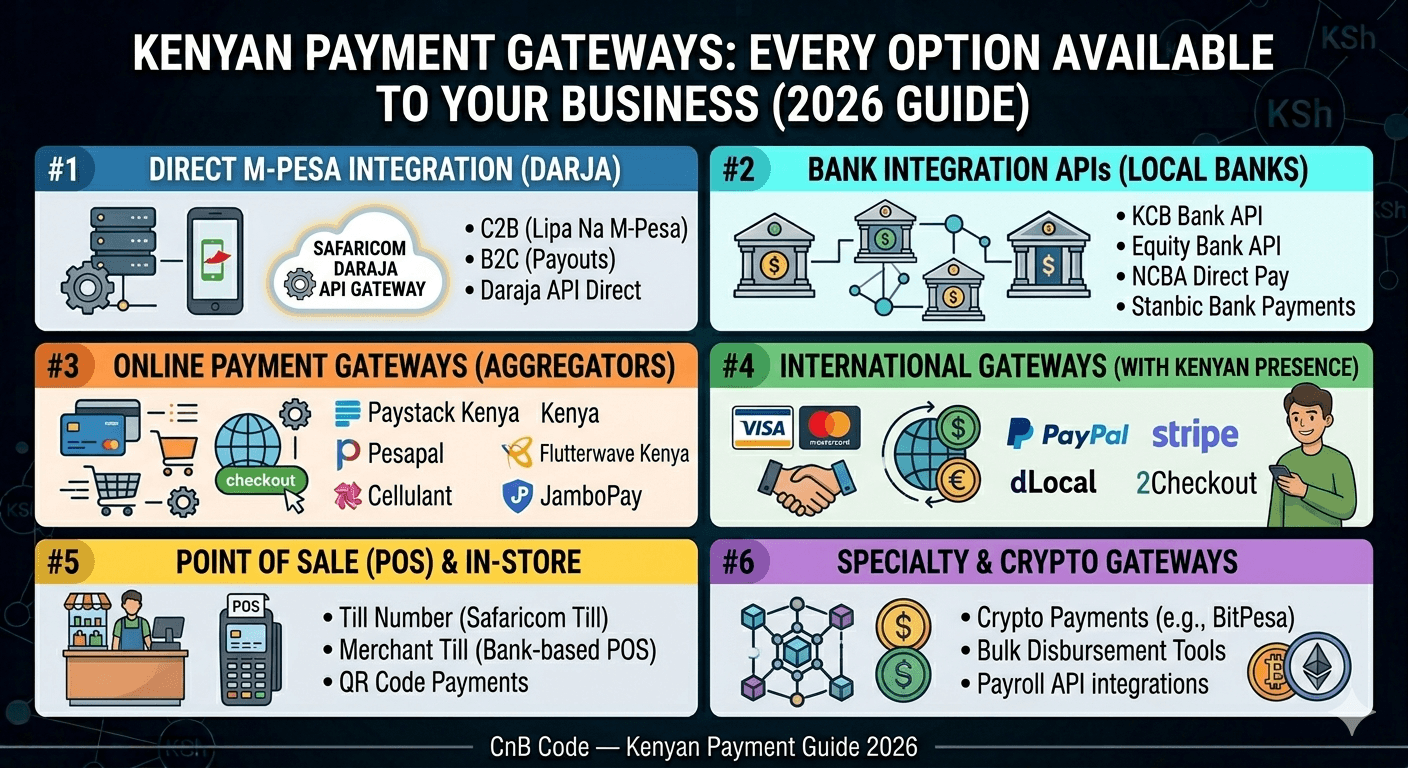
Payment Gateways in Kenya: Every Option Available to Your Business (2026)
Every payment gateway available to Kenyan businesses in 2026 — M-Pesa, cards, bank APIs, and cross-border options. Fees, features, and who each one is best for.
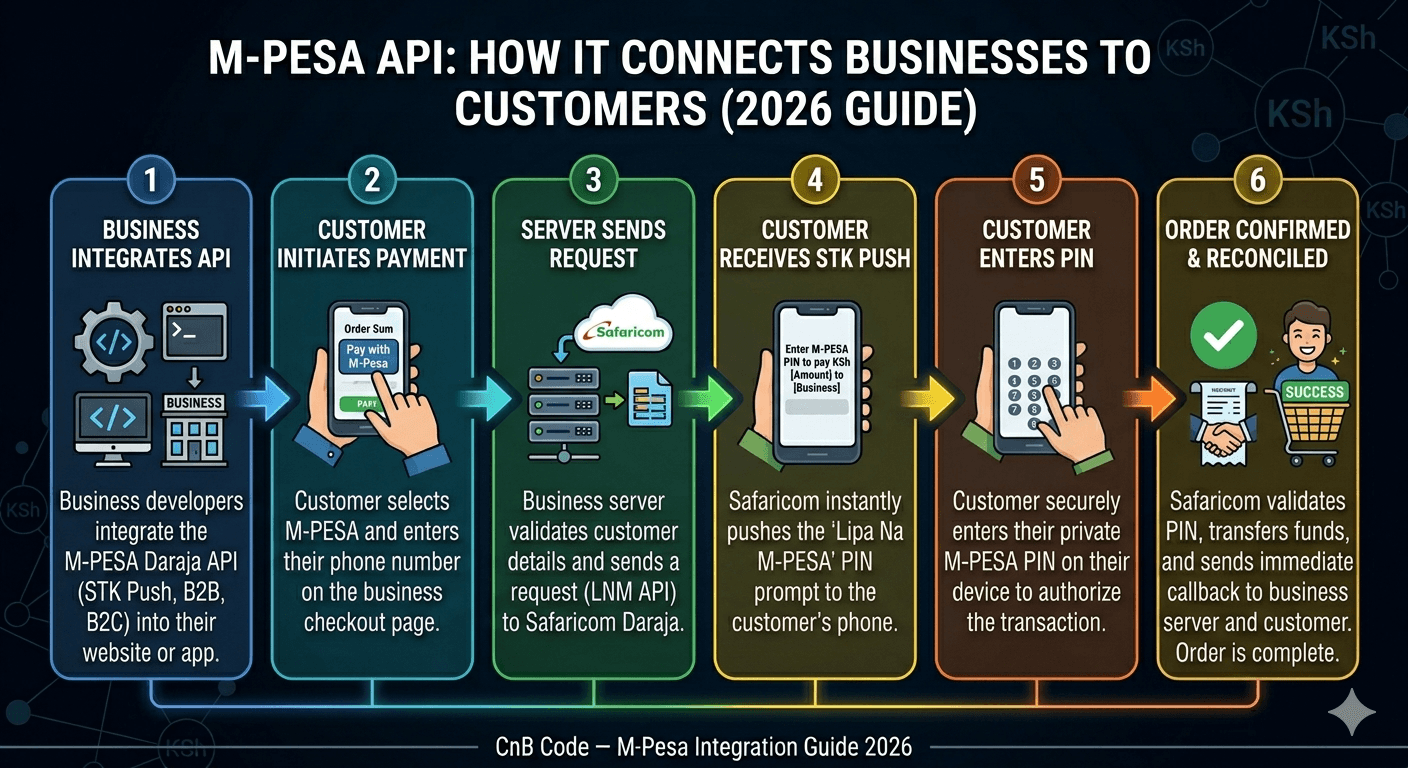
What is M-Pesa API and How Does It Work for Businesses?
M-Pesa API explained for Kenyan business owners. Learn how Daraja works, what STK Push means, and whether your business actually needs API integration.