Does Paystack Support M-Pesa in Kenya? (2026 Cost Breakdown)
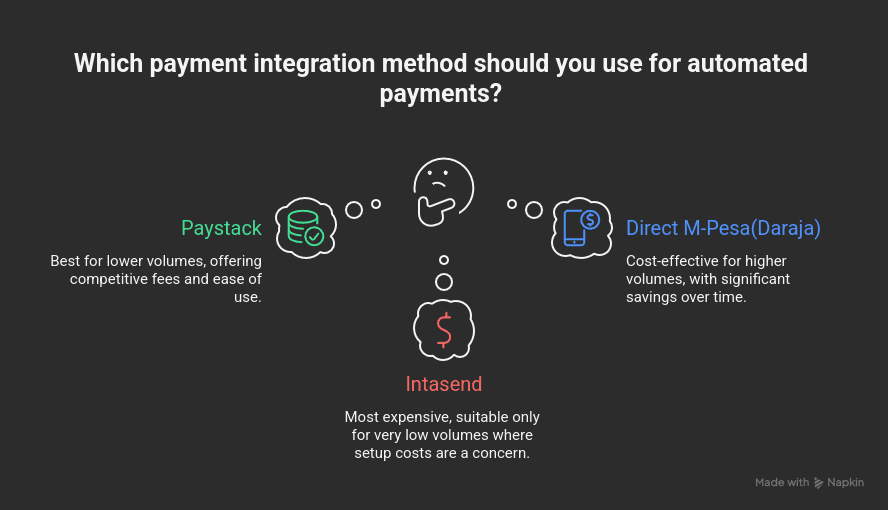
What You're Deciding
If you're setting up payments for a Kenyan business and wondering whether Paystack supports M-Pesa -yes, it does.
Paystack handles M-Pesa payments in Kenya through STK push, meaning your customers get the standard PIN prompt on their phone without you needing to touch Safaricom's Daraja API directly.
But whether Paystack is the right choice for your business is a different question — and the answer depends almost entirely on your monthly transaction volume.
This guide breaks down the real numbers, the break-even point, and exactly when it makes more financial sense to integrate Daraja directly instead.
Quick Takeaway:
Paystack costs 1.5% per M-Pesa transaction but launches in 1 week. Direct M-Pesa has lower fees but takes 5 weeks and costs KSh 100K+ to set up. Break-even point: KSh 500K/month volume. Most businesses should start with Paystack, migrate to Direct M-Pesa later.
Quick Answer: Which Payment Method is Right for You?
Processing less than KSh 300K/month?
→ Paystack
Processing more than KSh 500K/month?
→ Direct M-Pesa
Between KSh 300K-500K?
→ Either works, depends on your situation.
Cost Comparison: Real Numbers at Different Volumes

At KSh 100,000/month volume:
Paystack:
Collection fees: KSh 1,500 (1.5% of M-Pesa transactions)
Withdrawal to bank: KSh 140 (monthly batch)
Total: KSh 1,640/month
Setup: 1 week, ~KSh 20,000
Intasend:
Collection fees: KSh 3,000 (3%)
Withdrawal: KSh 100 (flat rate)
Total: KSh 3,100/month
Settlement: 72 hours (3 days)
Setup: 1 week, ~KSh 20,000
Direct M-Pesa:
Transaction fees: ~KSh 2,000 (standard M-Pesa rates)
Withdrawal fees: Varies (M-Pesa charges apply)
Total: ~KSh 2,000-2,500/month
Setup: 5 weeks, ~KSh 100,000
Verdict: Paystack is cheapest at this volume. Intasend is the most expensive + slowest settlement.
At KSh 500,000/month volume:
Paystack:
Collection: KSh 7,500 (1.5%)
Withdrawal: KSh 140 (batch weekly = ~KSh 560/month)
Total: KSh 8,060/month
Intasend:
Collection: KSh 15,000 (3%)
Withdrawal: KSh 100
Total: KSh 15,100/month
Direct M-Pesa:
Transaction fees: ~KSh 10,000
Total: ~KSh 10,000-12,000/month
Verdict: Paystack still competitive. Direct M-Pesa saves ~KSh 2,000-4,000/month.
Break even in ~20-50 months depending on savings.
At KSh 1,000,000/month volume:
Paystack:
Collection: KSh 15,000 (1.5%)
Withdrawal: KSh 140-350 (batch monthly)
Total: ~KSh 15,500/month
Intasend:
Collection: KSh 30,000 (3%)
Total: ~KSh 30,000/month
Direct M-Pesa:
Transaction fees: ~KSh 20,000
Total: ~KSh 20,000-22,000/month
Verdict: Direct M-Pesa saves KSh 6,000-8,000/month over Paystack. Saves KSh 10,000/month over Intasend. At this volume, worth it.
While Intasend markets heavily to Kenyan businesses, the numbers don't work:
Highest fees: 3% (double Paystack's 1.5%)
Slowest settlement:72 hours (vs Paystack's 24-48h)
No advantage:Same setup time as Paystack
The only time Intasend makes sense:
Never, for most use cases.
Unless you have a specific integration Paystack doesn't support, you're paying more for slower service.

When Direct M-Pesa Makes Sense
High volume (KSh 500K+/month)
Fee savings add up
Worth the setup effort
Fraud risk
Money hits your paybill instantly
Customer can't chargeback before you receive funds
Important for high-value transactions
Have infrastructure ready
Business registered
Bank account exists
All documents ready
Can wait 5 weeks
Want full control
Your paybill, your data. No middleman
Is your integration failing? Read more about the most common reasons as to why that is happening
When Paystack Makes Sense
Low-medium volume (under KSh 300K/month)
Fee difference not significant. Simplicity worth it.
Speed is critical
Need revenue this week
Testing business model
Can't wait 5 weeks
Missing infrastructure
No business bank account
Documents incomplete
Not formally registered
Multiple payment methods needed
Want card payments too
Airtel money support
International payments
One integration for all
Small team
No dedicated developer
Want managed solution
Prefer dashboard over custom code
The Hybrid Strategy: Start Fast, Optimize Later
Most successful approach:
Launch with Paystack (Week 1)
Get revenue flowing fast
Focus on product
Validate business model
Grow to KSh 500K+/month (Month 6-12)
Business is proven
Volume justifies effort
Have resources now
Migrate to Direct M-Pesa (Month 12+)
Now setup cost makes sense
Save KSh 60K-120K/year
Business infrastructure in place
Start fast, optimize later.

Real Business Scenarios
Scenario 1: SaaS Subscriptions
Business: Monthly subscriptions, Ksh 2,000-10,000 per customer.
Started with: Paystack
Live in days
Volume: KSh 200K-400K/month initially
Paying ~KSh 6K-12K/month in fees
After 8 months: Migrate to Direct M-Pesa
Volume: KSh 800K/month
Paystack fees: KSh 24K/month
Direct M-Pesa fees: KSh 16K/month
Save: KSh 8K/month = KSh 96K/year
Result: Smart. Used speed early, optimized later.
Scenario 2: Investment Platform
High-value transactions, KSh 10K-100K per payment.
Chose: Direct M-Pesa from day 1
Why: Fraud risk
Had chargeback scammers
Paystack holds funds 48 hours
Scammers disputed before settlement
Lost KSh 200K+
With direct M-Pesa:
Funds instant to paybill
Fight disputes from position of strength
Result: Worth the 5-week setup for security.
Scenario 3: E-Commerce
Average order KSh 3,000, mix of products.
Chose: Paystack (still using after 2 years)
Why:
Volume: KSh 400K-600K/month
Needs card payments (25% of orders)
Small team, no developer
Dashboard handles reconciliation
Result: Right choice. Multiple payment methods and simplicity worth 3% fee.
Settlement Speed Reality: How Fast You Get Your Money

Direct M-Pesa:
Customer pays → Instant to your paybill
Paybill → Bank: You control timing (instant withdraw or batch daily/weekly)
M-Pesa withdrawal fees apply when moving to bank
Paystack:
Customer pays → Paystack's account
Paystack → Your bank: Automatic in 24-48 hours
Pro tip: Batch withdrawals weekly/monthly (KSh 140 once vs KSh 140 daily)
You wait, can't control timing
Intasend:
Customer pays → Intasend's account
Intasend → Your account: 72 hours (3 days)
Flat KSh 100 withdrawal fee
Longest wait of all options
Impact:
Direct M-Pesa: Best for cash flow
Paystack: Acceptable for most businesses
Intasend: 3 days is long for small businesses with tight cash flow
Chargeback Protection Differences
Paystack (Settlement Hold Risk):
Day 1: Customer pays KSh 50,000
Day 2: Customer disputes
Day 3: Paystack investigates, holds money
You never received the funds
Direct M-Pesa:
Customer pays KSh 50,000 → Instant to your paybill
Later: Customer requests reversal
You already have the money, can provide evidence
For high-value transactions with fraud risk, direct M-Pesa is protective.
Technical Complexity Comparison
Developer Effort:
Paystack:
Integration: 2-3 days
Good documentation
SDKs available
Dashboard for testing
Support responds fast
Direct M-Pesa:
Integration: 5-7 days (code only)
Documentation improving
Must handle callbacks properly
More edge cases
Support slower
New to M-Pesa integration? See our complete Daraja API 2026 requirements guide
Your Decision Framework: 6 Questions to Answer
Answer these:
1. Monthly volume?
Under KSh 300K → Paystack
Over KSh 500K → Direct M-Pesa
Between → Keep reading
2. How urgent?
This week → Paystack
Can wait 5 weeks → Either works
3. Have business bank account?
No → Paystack (or open one first)
Yes → Either works
4. Fraud risk?
High (expensive items, fraud-prone) → Direct M-Pesa
Low → Either works
5. Need cards/international payments?
Yes → Paystack
No → Either works
6. Technical capacity?
Solo/small team → Paystack easier
Dedicated developer → Either works

Need help choosing a developer?
Read our guide on selecting an M-Pesa integration expert
Common Myths Debunked
"Direct M-Pesa is always cheaper"
→ False. Only at high volumes (KSh 500K+/month)
"Paystack is unprofessional"
→ False. Many successful businesses use it
"Can't switch later"
→ False. Migration possible both ways
"Direct M-Pesa is instant settlement"
→ Partial. Instant to paybill, but moving to bank still takes process
"Need developer for Paystack"
→ Partial. Basic integration is simple, but proper implementation still needs an professional developer
Bottom Line Recommendations
New business launching:
→ Paystack. Cheapest fees (1.5% M-Pesa) + fastest setup. Optimize later.
Established business over KSh 500K/month:
→ Evaluate both. Paystack still competitive at 1.5%, but direct M-Pesa saves ~KSh 5K-10K/month.
Business over KSh 1M/month:
→ Direct M-Pesa. Fee savings (KSh 6K-10K/month) worth the setup effort.
High-value transactions with fraud risk:
→ Direct M-Pesa. Instant settlement protects you from chargeback scams.
Need cards + M-Pesa +Airtel Money + international:
→ Paystack. One integration, multiple payment methods.
Solo founder, small team:
→ Paystack. Less technical burden, better docs and support.
Avoid:
→ Intasend. Higher fees (3%) + longest settlement (72 hours) = worst of both worlds for most use cases.
Bottom Line
For most new businesses: Start with Paystack.
Launch fast, validate your model, grow to profitable volume. Migrate to direct M-Pesa when you're processing KSh 500K+/month and fee savings become significant.
Don't over-optimize early. Getting revenue today beats saving 1% next quarter.
Ready to go the Direct M-Pesa route?
[Read our complete Daraja API integration requirements guide →]
Need Help Deciding?
🤔
Still not sure which option fits your business?
Get a Free 15-minute consultation
We'll review your:
Monthly transaction volume
Business setup status
Technical capacity
Fraud risk profile
Timeline requirements
And recommend what actually makes sense for YOUR situation.
❓
Want it done for you?
CnB Code handles both:
Paystack Integration:
Setup time: 1 week
Full integration and testing
Dashboard training included
Direct M-Pesa Integration:
Complete document handling
Safaricom liaison- Full development and deployment
Production go-live support
We've done this for dozens of Kenyan businesses and know exactly what works at different scales.
No pressure - we'll tell you honestly if DIY makes more sense for your situation.
Schedule Your Free Consultation
Want to know more? [See our payment integration services →]
Written by the Engineering Team at CnB Code
We build fast, scalable applications, complex API integrations, and automate business workflows. Based in Nairobi, serving ambitious businesses globally.
Need help implementing this? We're here to help.
Our engineering team at CnB Code specializes in building and integrating custom software solutions just like this for forward-thinking businesses.
Recommended for you
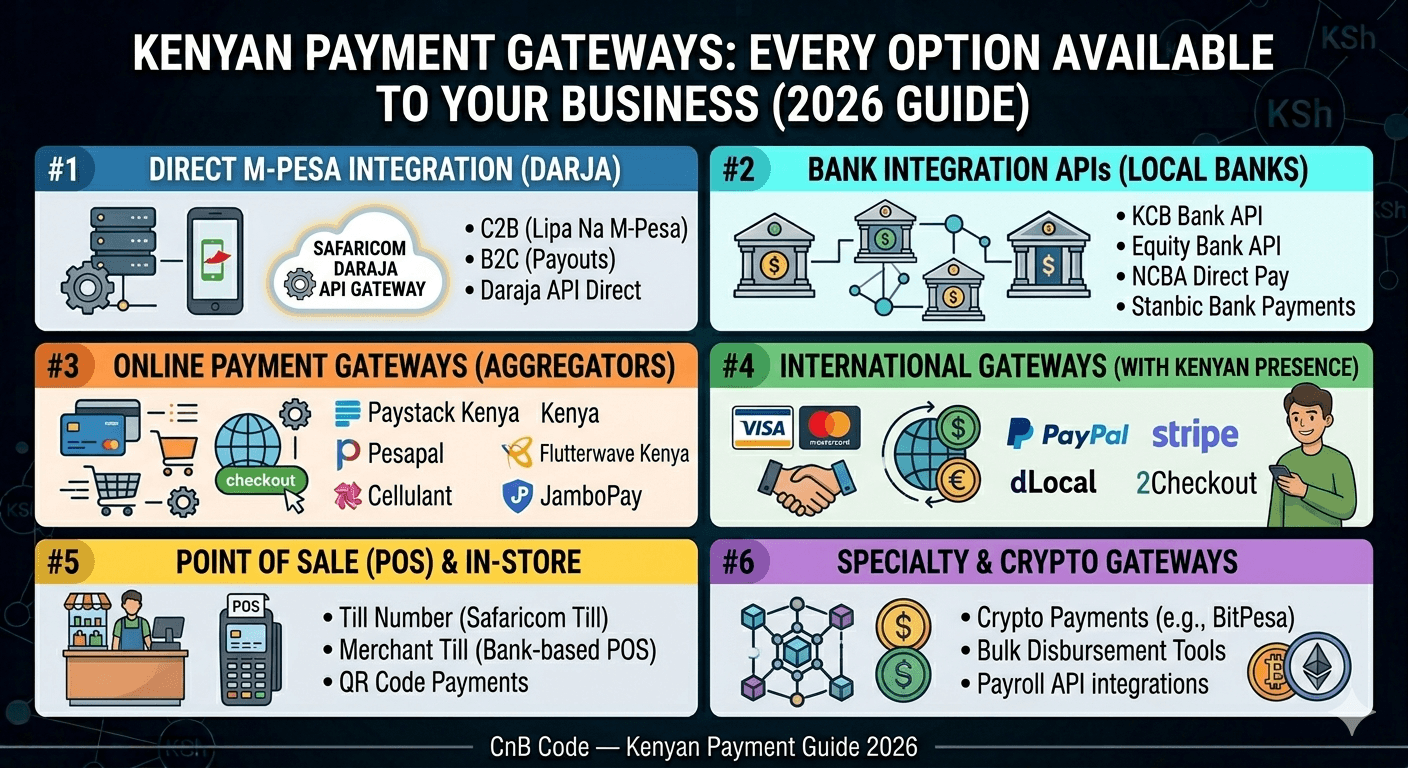
Payment Gateways in Kenya: Every Option Available to Your Business (2026)
Every payment gateway available to Kenyan businesses in 2026 — M-Pesa, cards, bank APIs, and cross-border options. Fees, features, and who each one is best for.
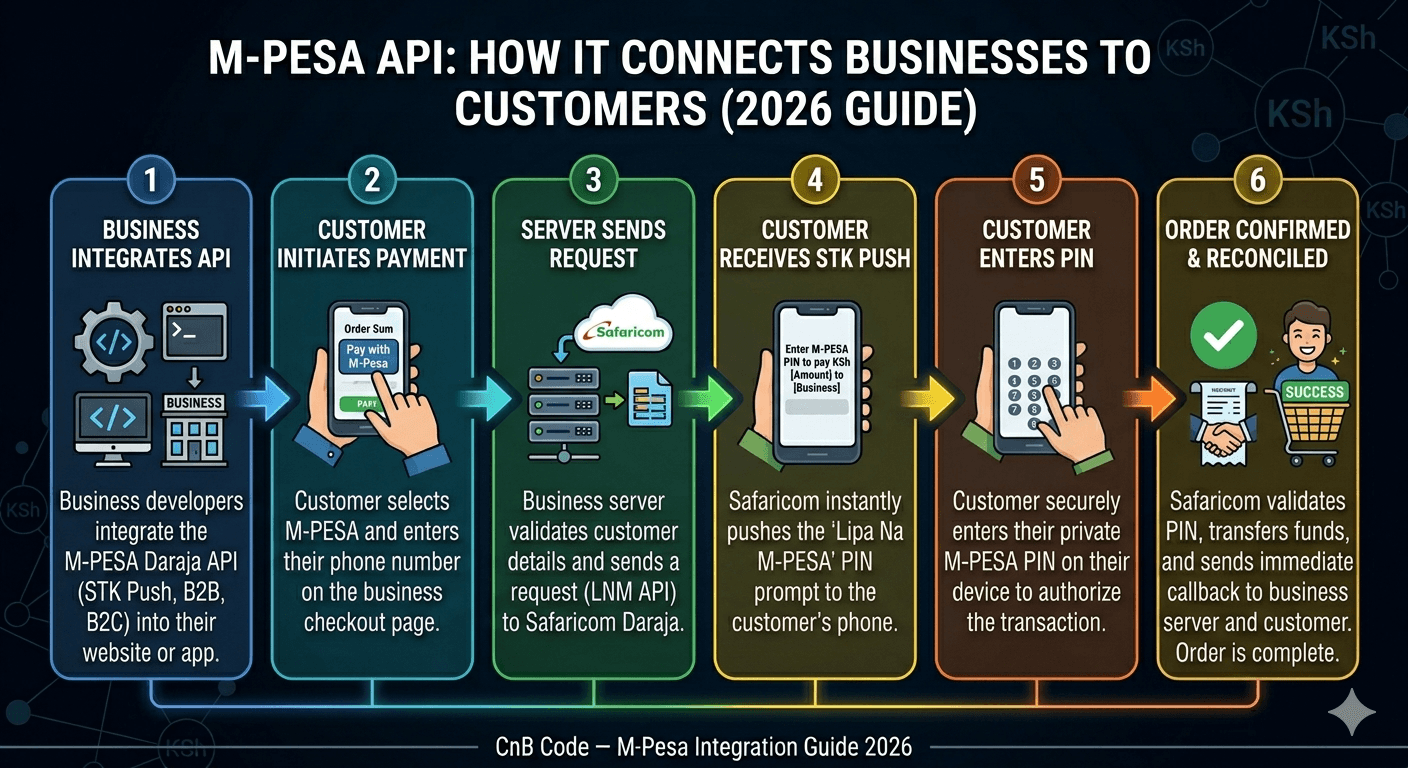
What is M-Pesa API and How Does It Work for Businesses?
M-Pesa API explained for Kenyan business owners. Learn how Daraja works, what STK Push means, and whether your business actually needs API integration.